Talk to us +44(0)1733 391377

Home Knowledge Hub Blogs & Insights Pay Market Insights What is the pay market telling us about 2027?

If there’s one thing HR and reward professionals could probably do without right now, it is another year of trying to work out what the “right” pay award looks like. On paper, things should be getting easier.

Inflation is nowhere near the highs we saw a few years ago. Pay awards have started to settle. Recruitment has cooled from the post-pandemic frenzy and, for many employers, labour turnover is no longer creating quite the same pressure. And yet, setting pay still feels anything but straightforward.

That’s what comes through from the early findings from the latest UK Reward Management Survey.

There are differences in the detail, but the broad direction is remarkably consistent: employers are not expecting dramatic changes in 2027.

Instead, most are trying to find a sensible middle ground between affordability, employee expectations, inflation and what the market is actually paying. This is where the difficult bit starts.

The 3 per cent question isn't going away

Our July pulse survey pointed towards a remarkably consistent picture for 2027, with 3 per cent emerging as the central expectation. The autumn UK Reward Management Survey’s initial data points in much the same direction.

The overall message is that there’s no obvious rush towards a significantly higher or lower pay round. But it doesn't mean the decision is easy. A 3 per cent headline figure might look straightforward. The reality underneath it isn't.

One organisation might be looking at 3 per cent because that is what it can afford. Another might be paying 3 per cent because that is what it believes the market requires. Another might have started at 3 per cent but is now questioning whether some of that budget should be targeted at particular roles, skills or performance. Same number. Very different reasoning. So perhaps the more useful question for HR isn't “Is 3 per cent the market rate?” It is: “What does the market rate mean for us?”

Affordability versus inflation

This is where things get particularly interesting. Affordability has consistently ranked as the number one influence on pay decisions, with inflation close behind. Market rates, recruitment and retention pressures, regulation and the National Living Wage also have their part to play. That combination probably sounds familiar.

Most reward professionals aren't setting pay in isolation. They are balancing a business case with an employee case. And those two cases don't always point in the same direction.

Inflation is a good example. It has fallen substantially from the extraordinary levels seen during the cost-of-living crisis, but it has hardly disappeared from the pay conversation.

The path ahead remains uncertain. The latest UK inflation data has shown some movement again and is expected to remain elevated, which is a reminder that the economic backdrop can change while organisations are still working through their pay timetable.

That matters because employees don't necessarily experience “headline inflation” in the same way as an economist does. Housing, food, energy and other household costs can feel very different from the overall CPI number. So even when inflation is technically much lower than it was a few years ago, employees may still ask why their pay award doesn't reflect the cost pressures they are experiencing.

Initial UK Reward Management Survey findings reinforce just how closely employers are still watching this. Initial results show that two thirds of employers expect inflation to influence their 2027 pay decisions. That is a significant proportion, but there is an important nuance here.

Influencing a pay decision doesn't necessarily mean following inflation. The July pulse survey found that more than half of organisations would stick with their existing pay prediction even if inflation fell further. A smaller proportion would reduce their planned award, with some considering a reduction of 0.5 per cent and fewer still looking at a reduction of 1 per cent.

In other words, inflation is part of the conversation. It isn't necessarily the formula.

The market matters too

If affordability is one side of the equation and inflation is another, market competitiveness is the third. And this is perhaps where a whole-of-market pay figure can only take you so far.

Our data shows that the labour market has become less competitive than it was at the height of the post-pandemic recruitment boom. Out-of-cycle increases have fallen from their 2022 peak and have been sitting at a more modest level. That doesn't mean market pressures have gone away. Far from it.

They have become more targeted. An organisation may be comfortable with a 3 per cent general increase but still have a problem in a particular job family.

Maybe it's struggling to recruit engineers. Perhaps it is losing experienced people in a specialist technical function. Or maybe salaries for a particular role have moved much faster than the wider market. This is where the headline pay award can become a bit misleading.

The organisation may say “we're giving 3 per cent”, but the real pay strategy could be considerably more nuanced. And the early data suggests that employers are thinking that way.

Our 2027 pay expectations showed a growing preference for combining an across-the-board increase with more individually targeted increases, rather than simply giving everybody exactly the same uplift.

When budgets are limited, there is a stronger argument for putting money where it is most needed. But it also makes the evidence behind those decisions more important.

Sector matters more than ever

This is probably one of the biggest lessons for anyone looking at national pay data. A whole-market median is useful. It gives you a reference point. It helps answer the question: “What are other employers broadly doing?” But HR teams rarely have to pay the whole market. They have to pay their market. And there can be meaningful differences between sectors.

Our early data, for example, showed some sectors sitting towards the higher end of the emerging range, while others were lower. Utilities and energy were showing higher levels, while healthcare was towards the lower end in the data available at the time.

That kind of information can change the conversation around a pay budget. If the overall market is sitting at 3 per cent, but your sector is consistently paying closer to 3.5 per cent, a 3 per cent award may carry a different recruitment and retention risk than it would elsewhere. Equally, if your sector is consistently around 3 per cent, paying significantly more needs a clear business rationale.

This is why HR professionals should be wary of relying too heavily on a single headline number. The number is the starting point, not the answer.

The real challenge: making the number defensible

Ultimately, the biggest challenge for HR professionals isn’t finding a pay award number. There are plenty of surveys that will give you one. The harder job is being able to explain why you've chosen it.

Why 3 per cent? Why not 3.5 per cent? Why is a particular function getting more? Why are you comfortable with a lower increase in another area? And what happens if inflation moves again?

Those are much harder questions. A strong pay decision needs to bring together several pieces of evidence: affordability, inflation, market movement, recruitment and retention, internal equity and, increasingly, the specific dynamics of the sector you're operating in.

That is where more detailed pay intelligence becomes particularly valuable as we move towards the 2027 pay round.

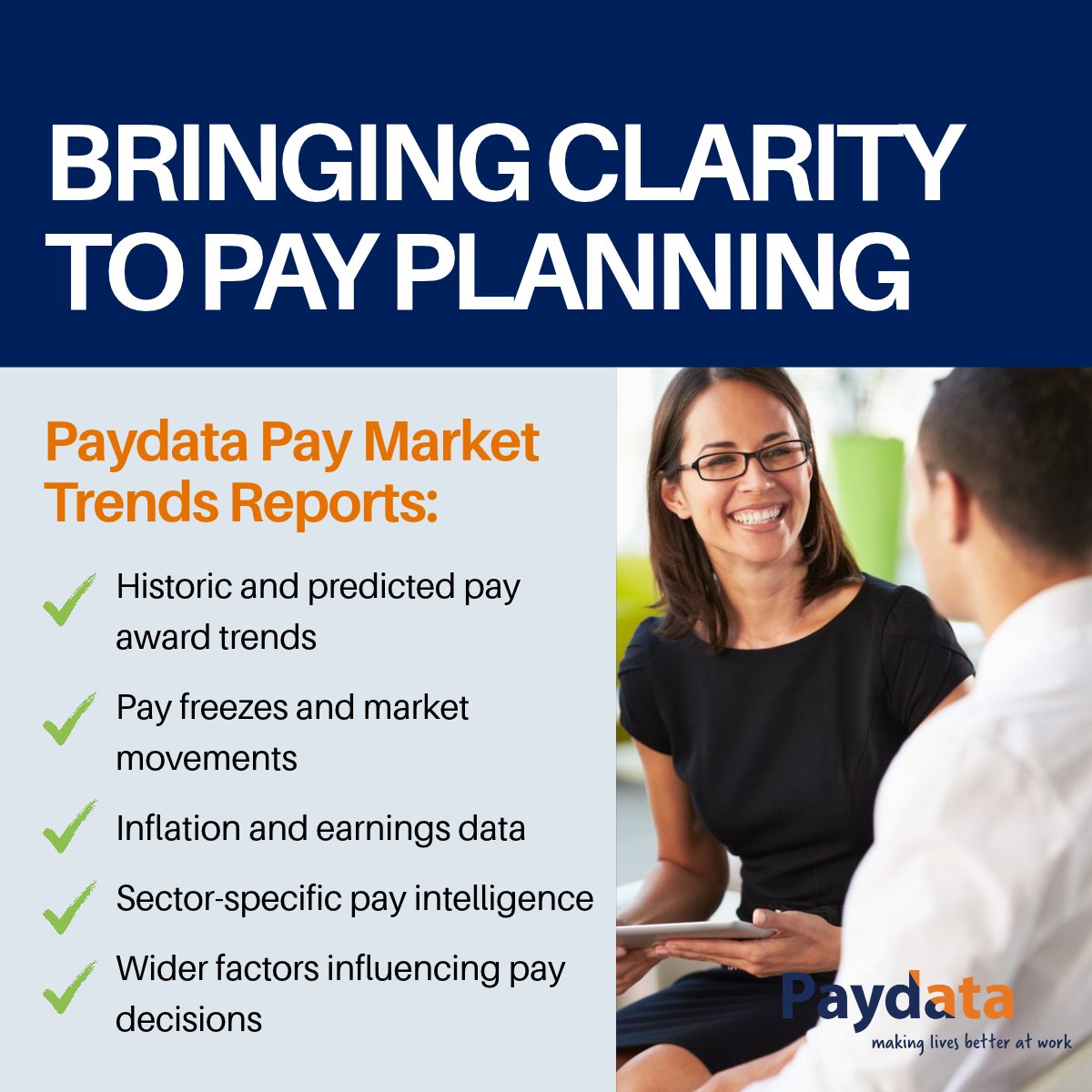
Our Pay Market Reports are designed to give HR and reward professionals that broader view, combining national pay trends and economic indicators with sector-level insight. They also provide historic context and forward-looking information, helping organisations see not just what the market is doing, but how their own sector compares. And importantly, the reports can be updated within six months of subscription, so you aren't necessarily making a 2027 decision based on a snapshot that was accurate six months ago but has since moved on.

Because if the last few years have taught us anything, it is that the pay market can change. Sometimes quite quickly.

For HR teams, the answer isn't to predict every twist and turn. It is to have enough reliable market evidence to make a decision that is affordable, competitive and, perhaps most importantly, one you can explain. The emerging 2027 data gives us a useful starting point. The real question is what this means for your organisation and your sector. That’s where the detail really matters.

Contact Us

Paydata Ltd
24 Commerce Road
Lynchwood
Peterborough
Cambridgeshire
PE2 6LR

info@paydata.co.uk +44(0)1733 391377
Sign up to insights

Be the first to hear about upcoming events and stay up to date with regular insights on pay and reward.

Get our advice

Contact our experts for free advice.

Call us — +44(0)1733 391377

Accreditations
Logos Logos