If you aren’t sure what services you require, reach out to us. We are happy to assist.
Talk to us +44(0)1733 391377
Date: 25 July 2024
We will be keeping a close eye on developments in the coming months to see how the situation evolves. Here are the projections on pay so far.
Between the financial crisis of 2008 and up until the pandemic, pay levels had remained stable and tracked inflation at around two per cent. This consistent pay award up until 2021 then faced numerous market pressures, making pay awards hit their highest levels for over a decade in 2023.
In 2023, inflation was the key driver for higher pay awards being a necessity. The cost of living crisis put huge strain on pay packets for employees, while employers struggled to balance rising operational costs with offering meaningful pay awards.
However, inflation has been falling since early 2023. In May 2024, in line with government promises, the Consumer Price Index (CPI) finally hit the two per cent target. This eases pay pressures for late 2024 and 2025 decisions on pay awards. The Monetary Policy Committee expects that inflation will be between two and three per cent in the next three years, suggesting that pay awards may fall back to pre-pandemic levels where they track inflation.
Overall, cumulative annual pay awards compared to inflation show that over the past decade, annual awards have consistently tracked higher than CPI, until 2023 when the CPI surpassed them by 0.6 per cent.
However, this picture will be nuanced depending on certain sectors. When pay rises have been below the level of inflation, they can be considered ‘real-terms pay cuts’ as prices are rising quicker than yearly wage increases. The impact is that employees’ incomes will not go as far. As growth in the public sector reportedly significantly trailed private sector, this was exacerbated by the cost of living crisis and led to widespread strike action.
The median pay award was five per cent, increasing by one per cent from July 2022 predictions. However, according to Paydata’s Pay Database, 2024 pay awards are broadly the same or marginally less than predicted in July 2023, at 4.5 per cent.
Out of cycle pay increases, excluding those awarded to reflect promotions, became popular post-pandemic. The competitive labour market is highlighted by the rise in out-of-cycle pay increases after 2020. Despite dipping slightly last year, the figures have recovered to 2019 levels this year. These ad hoc increases when used to bridge the gap between pay awards and market pressures, or to retain employees, continue to risk undermining the pay framework and budget certainty for HR.
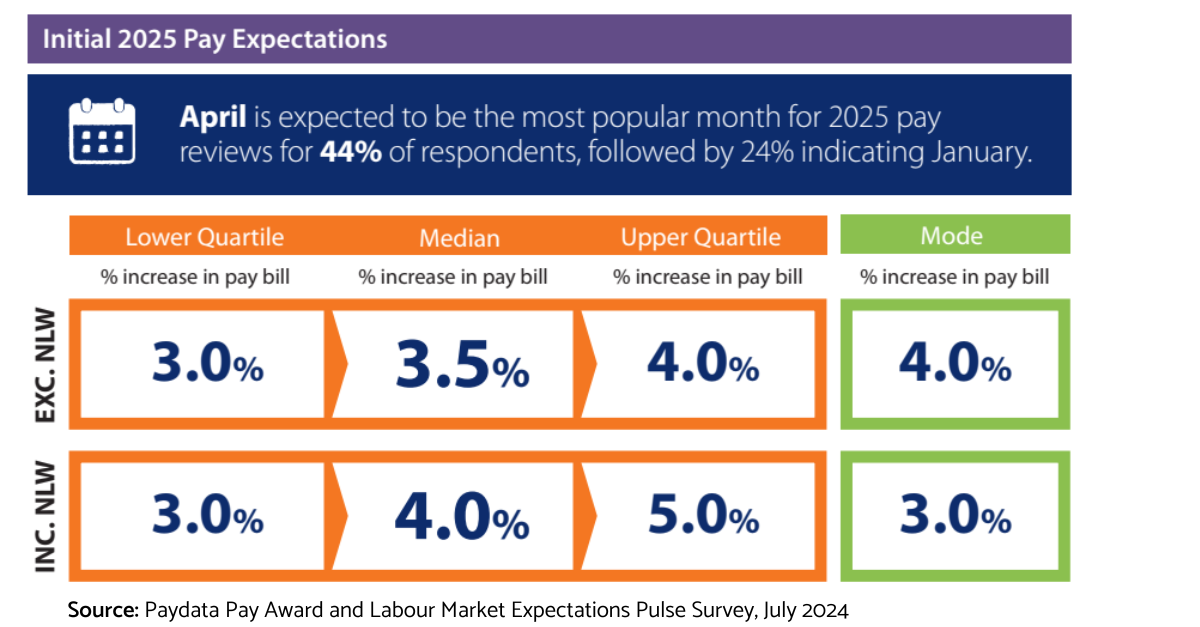
Looking towards pay trends for 2025, the current pay predictions suggest that the median pay award across all sectors will be 3.5 per cent. Overall, pay awards are currently predicted to reduce by one per cent next year.
When looking at both 2024 and 2025 pay awards on an individual-employer basis, around a third of organisations are paying the same award for both 2024 and 2025. The remaining two thirds predict a median reduction of 1.3 per cent, within a range of -0.5 per cent and two per cent.
In 2024, the median pay award for those affected by the National Living Wage was one per cent higher than pay awards offered by employers who are not affected by the NLW. This suggests the National Living Wage contributed an additional one per cent to affected employers’ overall pay bills. Many are carrying out compression analysis to help maintain competitive pay levels.
There is also the question of how much of an influence the next National Living Wage increase will have on employers’ 2025 pay budget decisions. 21 per cent of organisations indicate that a median additional 1.8 per cent of payroll could be spent on the National Living Wage, within a range of 0.5 per cent to 2.5 per cent.
In 2024, pay awards were predominantly awarded on an across-the-board basis. When asked about how 2025 pay awards will be distributed, more employers will use a combination of across-the-board and individual pay increases. This raises the question about how to make pay decisions fairly and consistently.
Flexible working arrangements have raised the issue of whether pay packets should reflect reduced commuting costs. The successful trial of flexible working for frontline staff has shown a boost to job satisfaction and wellbeing and many have adopted flexible working successfully across their organisations since the pandemic. However, trying to factor in the impact of remote working to pay decisions may make the pay framework more complex and make decisions less objectively fair.
Respondents to our Pulse Survey predicted that pay actions in 2025 are most likely to be driven by external relativities. 58 per cent think that employee turnover will stay the same, which may help stabilise pay award decisions over the next year. Pay parity is also important in order to uphold the integrity of pay frameworks, therefore some respondents are prioritising reviewing their pay structure.
This reflects our UK Reward Management Survey results, where 68 per cent cite external relativities as the main driver of their pay actions. This was followed by 53 per cent saying that internal relativities are driving their pay decisions; while 39 per cent are targeting high performing people with pay increases.
If you have any questions about planning your pay reviews for this year and scoping budgets for 2025, feel free to call us to discuss. You can also join us at our HR and Reward Conference 2024, taking place in central London on 17th September. Register to attend the popular event in the HR calendar, where you can expect to hear from expert speakers on topical HR and Reward issues, helping you fine tune your total reward strategy.
Managing Director
Date: 16 February 2026
Date: 11 February 2026
Date: 5 February 2026
We are a leading source of UK salary data and provide the expertise, insights and tools to help HR professionals manage their pay and reward practices.
Paydata Ltd
24 Commerce Road
Lynchwood
Peterborough
Cambridgeshire
PE2 6LR
Be the first to hear about upcoming events and stay up to date with regular insights on pay and reward.
© Paydata Ltd 2026 All rights reserved | Registered in England no: 3632206 | VAT no: 728 0808 28
Site by i3MEDIA